



Book Your Robotic Joint Replacement Consultation Today
Robotic Surgery at Shalby Hospital
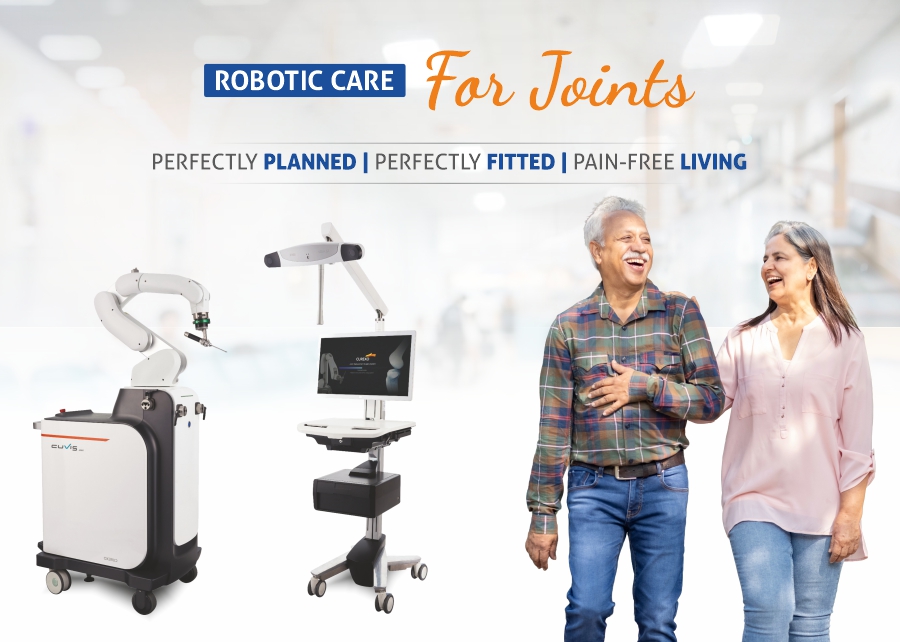
Advanced Orthopaedic Care with Cuvis Robot
At Shalby Hospital, we use advanced robotic technology to make orthopaedic surgeries more accurate and safer. The Cuvis Robot is specially designed only for orthopaedic procedures, such as joint replacement surgeries. Robotic surgery helps doctors plan and perform surgery with better precision. This means the surgery is done with more care, less damage to nearby tissues, and better results for the patient. With robotic support, patients can experience:
- Better alignment of joints
- Faster recovery
- Less pain after surgery
- Improved long-term movement
Our Specialities
Specialized Care for Ortho Robotic Surgery
Experienced Orthopaedic Surgeons
Our joint replacement team has strong expertise in advanced surgical techniques.
Robot-Assisted Precision
CUVIS helps surgeons make exact cuts and align the joint properly.
Personalised Surgery Planning
Every patient’s bone structure is different. Robotic planning is customized for your body.
Better Recovery Support
Our team provides complete care—from surgery to physiotherapy and rehabilitation.
Trusted Joint Replacement Centre
Shalby has a long-standing reputation in orthopaedic surgery and joint care.
Our Experts







Who Can Benefit from Robotic Orthopaedic Surgery?
Robotic surgery may be suitable for patients who have:
Severe knee pain due to arthritis
Difficulty walking or climbing stairs
Knee joint damage
Need for knee replacement surgery
Poor quality of life because of joint pain
A doctor evaluation is needed to confirm if robotic surgery is the right option.
Testimonials
Real Stories, Real Impact.
Tanzania Patient's Successful Anti-reflux Surgery | Dr. Anish Nagpal | Krishna Shalby Hospitals
Frequently Asked Questions
CUVIS Joint is a robotic system that helps surgeons plan and perform joint replacements with high accuracy. It uses 3-D planning, sensors, and a robotic arm to guide bone cuts.
No. The surgeon remains responsible. The robot assists with planning and precise cutting; the surgeon controls the steps and makes final decisions.
Robotic systems aim to increase precision and consistency, which can improve implant fit and reduce some risks. Long-term outcomes depend on many factors (patient health, implant type, rehab). Recent studies report promising accuracy with robot assistance.
Patients who need knee or partial knee replacement and want a personalised surgical plan are good candidates. Your surgeon will assess medical fitness, bone quality, and overall health before recommending surgery.